

Retailpath: From Vendor to Market, Faster
A retail marketing platform that connects three critical workflows in one system — product information management, retail promotion production and vendor onboarding. Simple Retailpath ensures product data is accurate, promotions are produced quickly, and everything from vendor to marketplace runs without the manual effort that slows retail teams down.

Manage Products
A single, richly detailed product library — images, copy, attributes, specifications and channel variants — that every team sources from with confidence, across every channel.
Brief to Market
Template-driven promotion setup, drag-and-drop mud mapping and auto-generated studio-ready briefs move every eDM, catalogue and digital promotion from brief to approved artwork faster, with fewer errors.
Onboard Vendors
Vendors submit product data directly into the platform. Automatic quality validation, mandatory field enforcement and ERP integration mean accurate product data arrives ready to use — without manual processing.
Our Customers







Product Library & PIM: One Accurate Record for Every Product
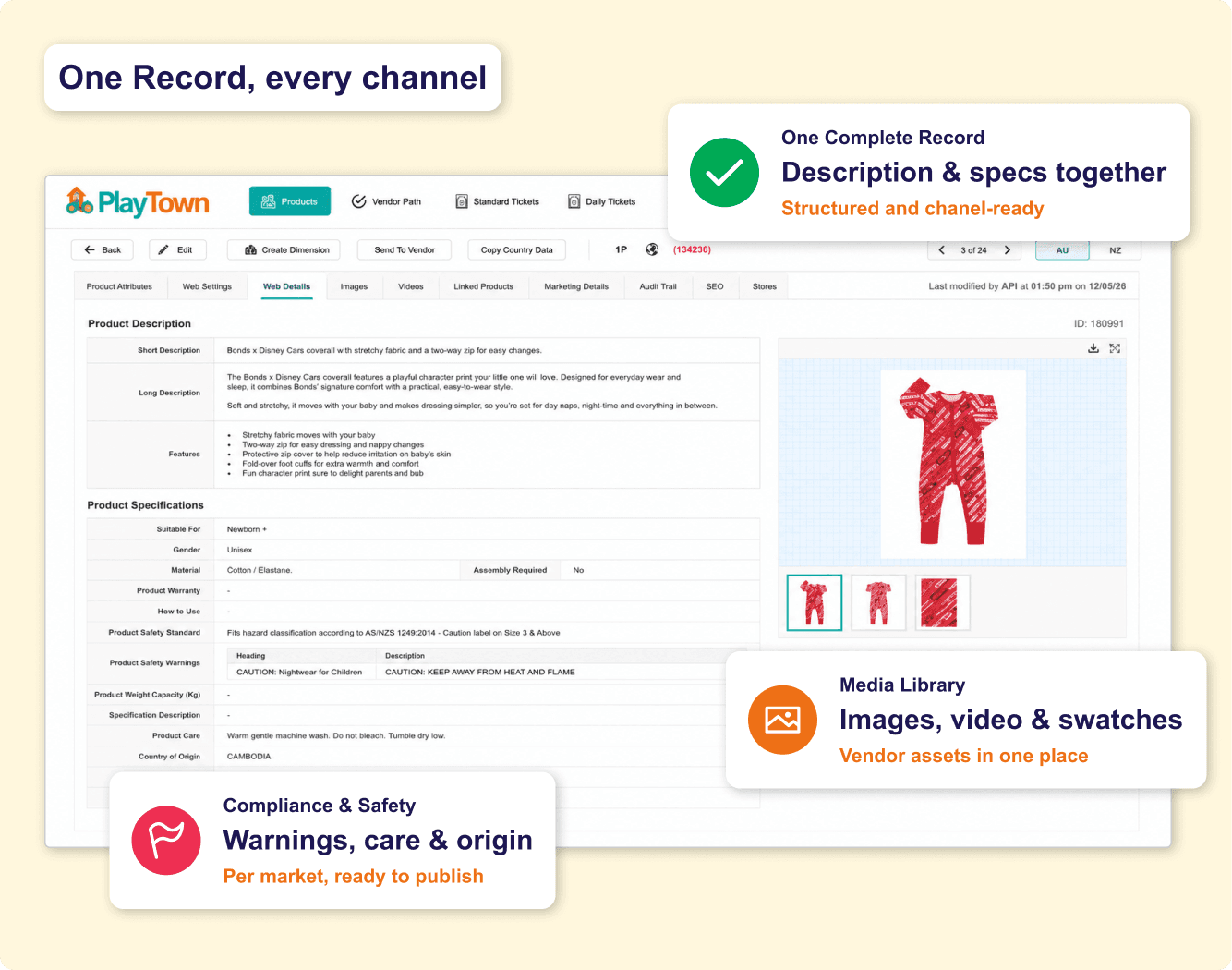
Inconsistent, incomplete or out-of-date product data costs retail teams significant time downstream. Simple Retailpath's PIM creates a single master record for every product — stored centrally and pushed to every team and channel from one source.
• All product data, images, copy, attributes and pricing in one central library.
• Product groups apply shared attributes across a range — no product-by-product re-entry.
• Built-in image management with cropping tools and swatch creation — no design team needed.
• Set image sequencing and defaults for web and print separately.
• Marketing teams self-serve with confidence — information is current, approved and accurate.
• Channel-specific customisation for Amazon, Shopify, eBay, Catch and other marketplaces.
Explore how product information management works as a retail strategy foundation, or see how Simple Asset Manager extends digital asset management for broader marketing libraries.
Retail Promotion Management: Brief & Build
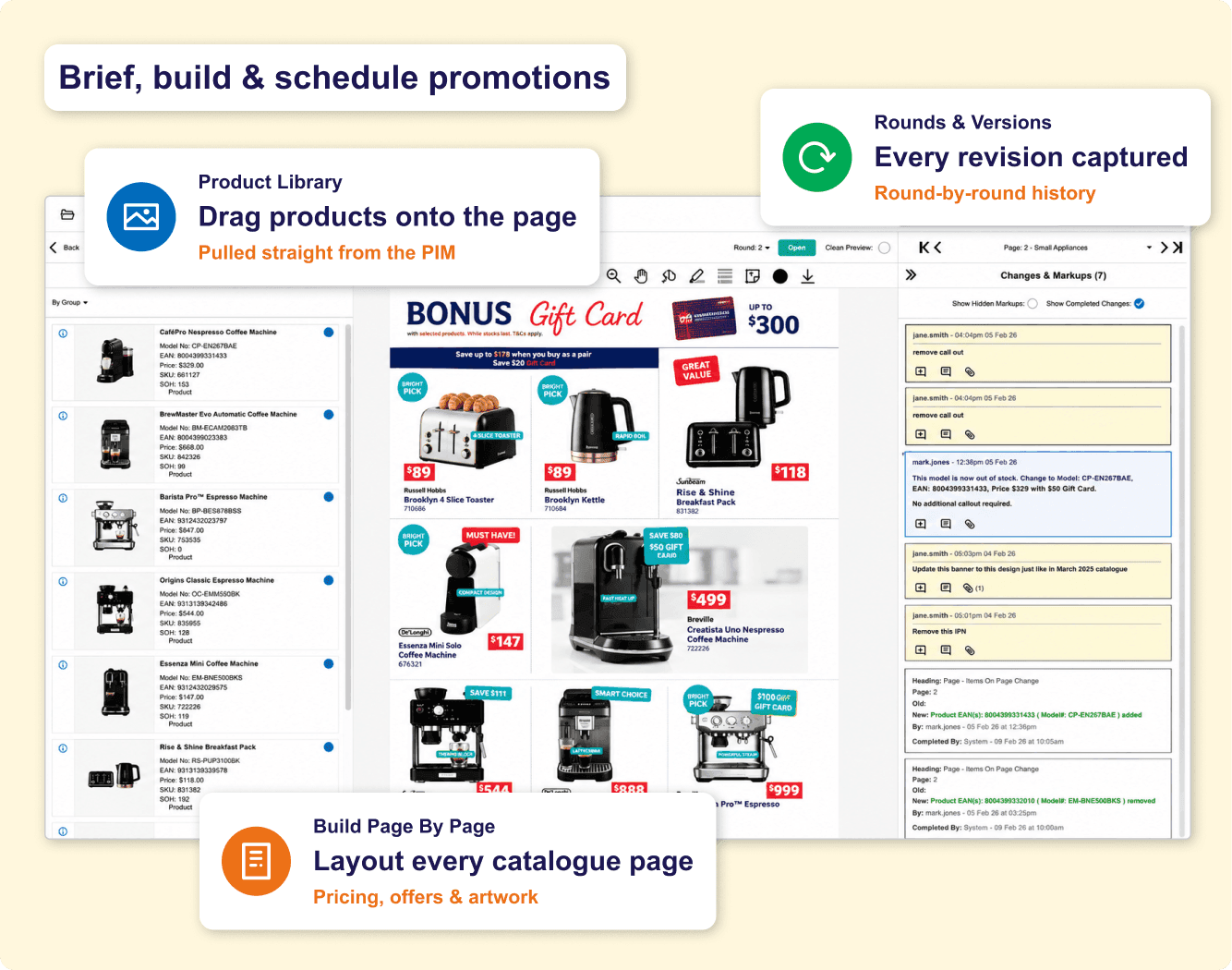
Retail promotion production starts long before the design studio gets involved. Retailpath's templated briefing and mud mapping tools give marketing and merchandise teams the structure to define, plan and visualise every promotion before a single design file is opened.
• Templated brief setup — promotion, key dates and approval pathway defined from the start.
• Buyers assign template pages to merchandise categories and populate from the PIM — drag and drop directly.
• Mud mapping gives buyers a visual page preview before it reaches the design studio.
• Studio-ready briefs generated automatically in InDesign — product images, copy and pricing pre-loaded.
See how retail marketing production is managed end to end, or read the complete guide to product information management as the foundation for promotion production.
Retail Promotion Management: Review & Approve
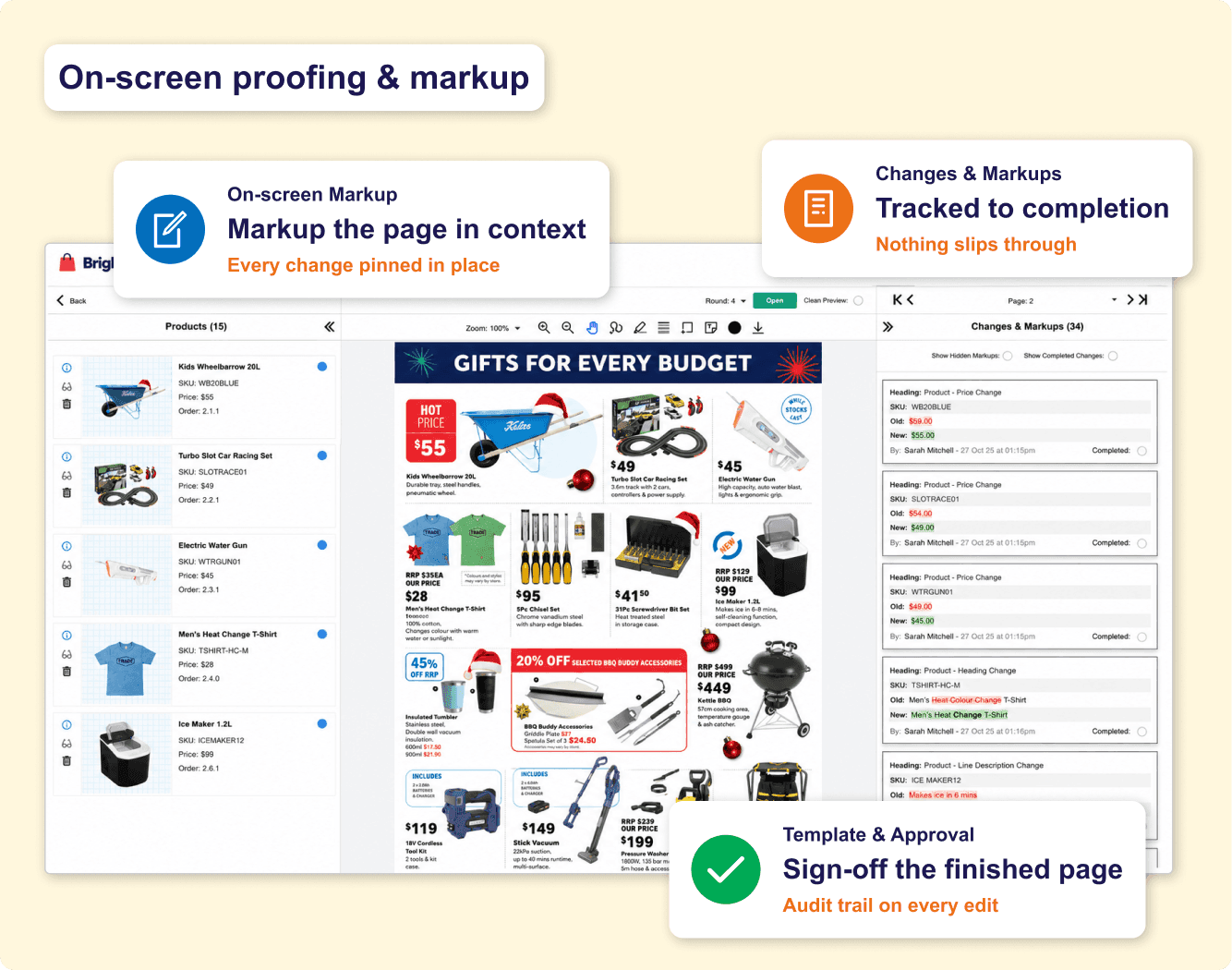
Getting a retail promotion from studio to market requires structured review, clear feedback and documented sign-off. Retailpath's online proofing and approval tools replace email chains and version confusion with a single, auditable process.
• Online proofing and markup — all reviewers annotate and approve directly on artwork.
• Collated feedback reaches the studio as one clear set of instructions — no contradictory emails.
• Change logs record every revision request — full audit trail for compliance and quality management.
• Multi-tiered approval pathways — every required sign-off completed before material is published.
Explore approval workflow software for the full structured sign-off capability, or see how marketing compliance software supports regulated retail marketing teams.
Our Customers



Vendor Onboarding: Accurate Product Data, Direct from the Source
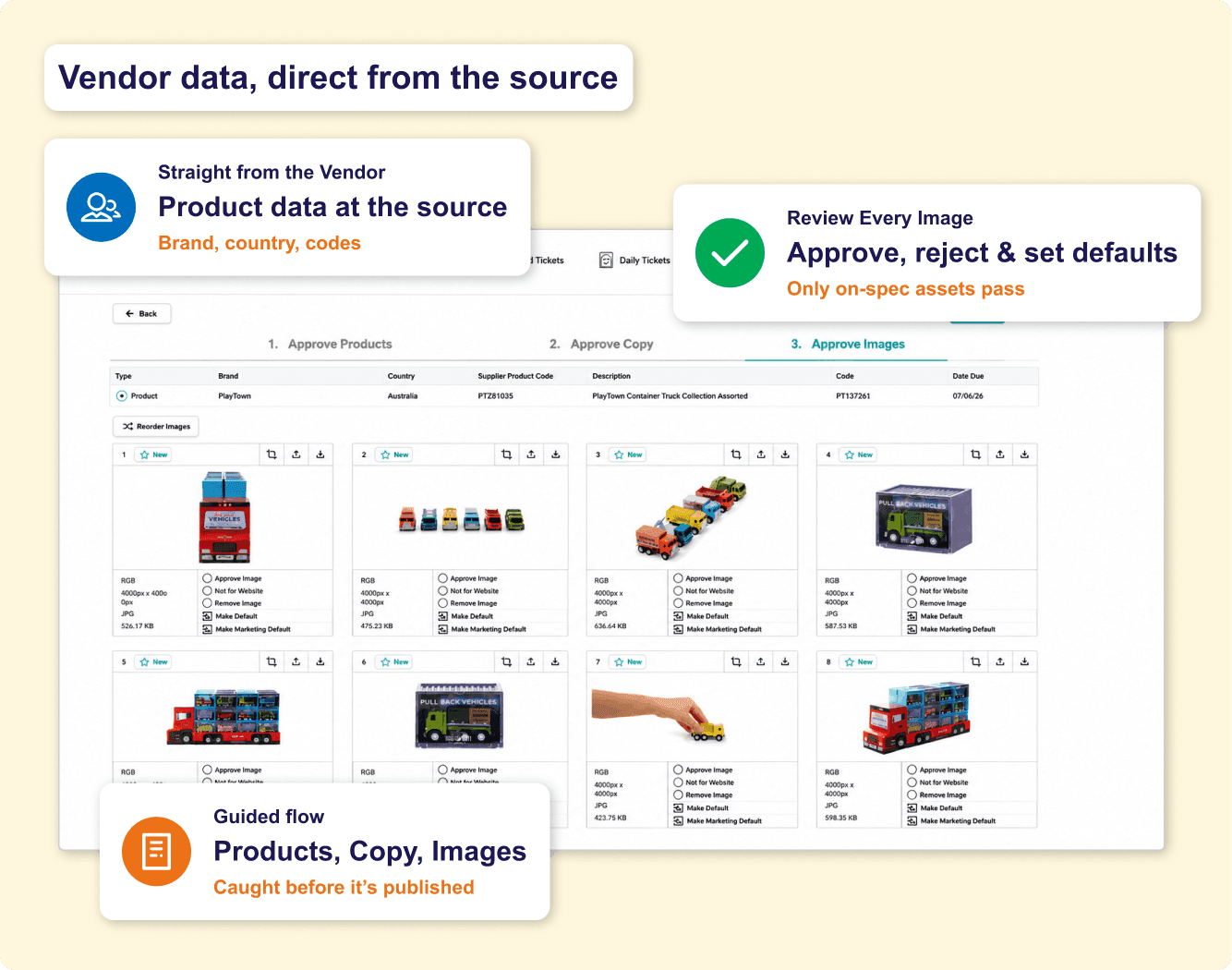
Product data quality starts with vendors — and poor data at source means manual corrections, delayed listings and promotion errors downstream. Retailpath's vendor onboarding module automates the intake process so product data arrives correctly formatted and fully validated.
• Vendors upload images, descriptions, specifications and SKU data directly into Retailpath — no spreadsheet handoffs.
• Automatic quality validation at upload — vendors prompted immediately to correct non-compliant files.
• Mandatory fields ensure vendors provide everything required before a product enters the library.
• Batch upload handles large-scale onboarding — range launches, seasonal updates and new vendor integrations.
• API integration connects directly to vendor ERP systems for automated, continuous data synchronisation.
• Merchandise teams review and approve vendor submissions before products enter the PIM library.
Read the PIM vs DAM guide to understand the distinction between product information management and digital asset management — and when each is needed.
Reporting & Visibility: Know Exactly Where Every Product and Promotion Stands
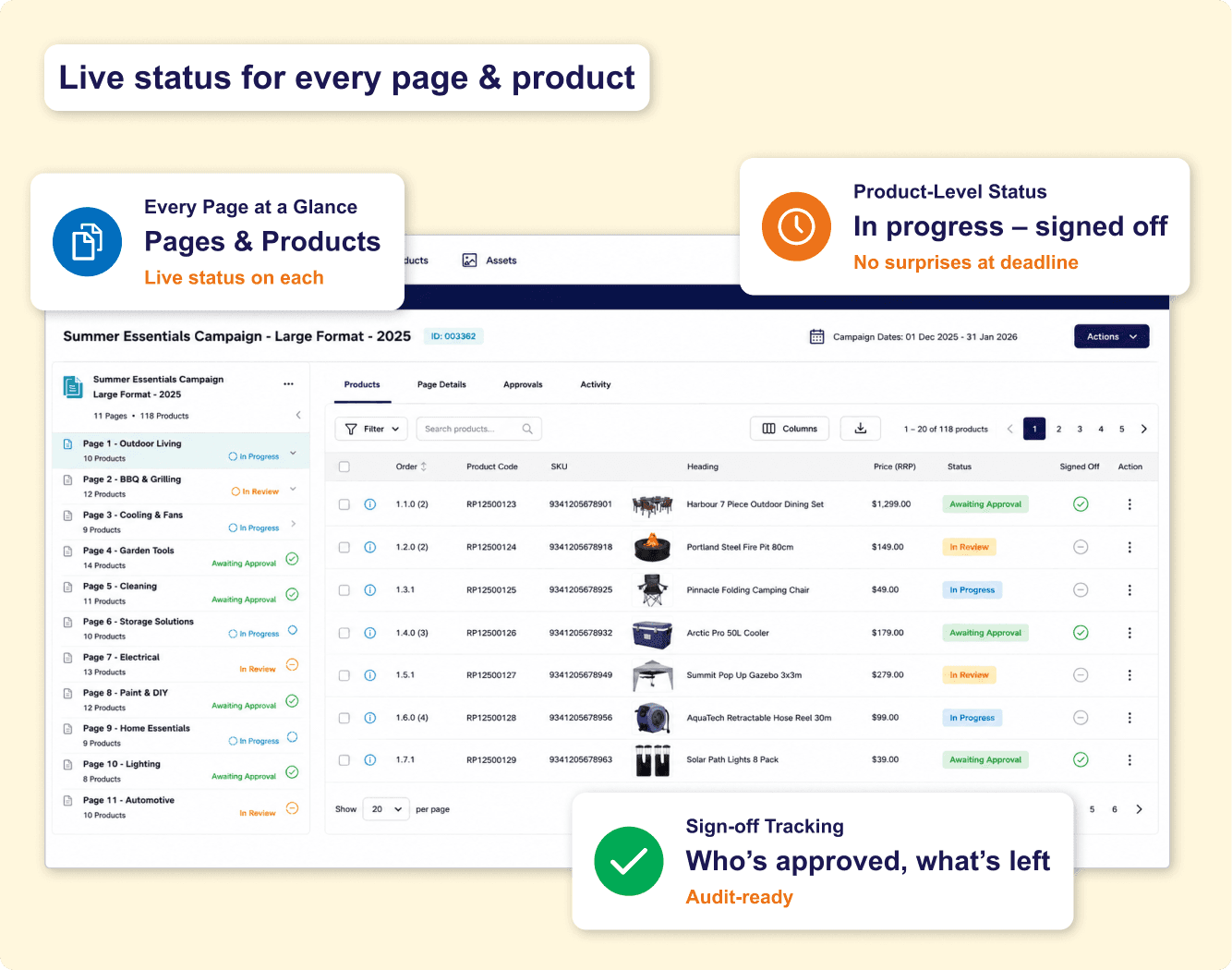
Retail production involves multiple concurrent promotions, large product volumes and several teams working in parallel. Retailpath's reporting tools give operations managers a live view of the entire pipeline — so delays are visible before they become problems.
• Promotion overviews show status of every active retail activity — what is outstanding, where delays are forming.
• Product history shows every promotion a product has appeared in — context for future decisions.
• Summary reports collate all stakeholder feedback — one pass replaces multiple touchpoints.
• Change logs record every revision request with timestamps — essential for compliance audits.
• Customisable reporting tracks metrics by promotion type, vendor, product category or timeline.
See how retail marketing teams use Retailpath across high-volume promotion cycles, or read The Complete Guide to PIM for Retail for a detailed walkthrough of how the platform works in practice.
Retailpath – Features
Product Library - PIM
A single source of truth to store and manage product information and assets including name, attributes, images, product copy with variations for print, web, email and marketplaces, icons and logos.

Product Groups
Products come in different colours and sizes. Store and manage shared content for a group of products, while also controlling images and information that is unique to one product.

Product Images
Product Images are an important part of Retail. The PIM allows you to set the Image Order/ Sequencing and set defaults for Web and Print. Built-in Cropping Tools and Swatch Creation save involvement from the Design Team.

Promotion Set Up
Marketing kickstart the process by creating the activity, setting key dates and allocating pages to Merchandise Categories.

Template + Disclaimer Library
A range of custom templates help manage brand consistency across marketing campaigns and the disclaimers library ensures marketing compliance obligations are met.

Mud Mapping – Product Placement
Drag & drop products onto the online Template, and build a PDF preview of the eDM, advert or catalogue page. This forms the first brief to the design studio.

Studio ready Brief
Save time on artwork creation by with the promotion brief supplied as an InDesign File with Product Images, Pricing, Copy and Callouts positioned on the page. Reduce risk or error and create first version faster.

Online Review with Markup Tools
Review artwork online and mark up changes via a complete set of online proofing tools. Product and Price Changes are updated via the PIM so the master file is always up-to-date.

Change Logs
Change requests are communicated to the Design Team via summary reports and checklists. This ensure that nothing gets lost and feedback is received via a consistent process.

See Simple Retailpath in Action
Book an interactive Product Tour.

Frequently Asked Questions
What is Simple Retailpath?
Simple Retailpath is a retail marketing platform with three tightly integrated modules: a Product Information Management (PIM) system that stores and manages all product data, images and specifications in a central library; a Retail Promotion Management module that streamlines the production of eDMs, catalogues and promotional content from brief to approved artwork; and a Vendor Onboarding module that automates the intake of product data from suppliers with built-in quality validation. Used by The Good Guys, Spotlight, Mitre 10, IGA and Betta, Retailpath is designed for retailers and brands managing high volumes of products across multiple channels, where speed to market, data accuracy and promotion compliance are operational priorities. See the retail and e-commerce use case for how Retailpath is applied across different retail operations.
Who uses Simple Retailpath?
Simple Retailpath is used by four teams across retail organisations, each with a distinct role in the product and promotion workflow. Marketing teams set up promotions, create the brief, select templates and manage the approval pathway from brief through to final artwork. Merchandise teams and buyers manage product categories in the PIM, select products for promotions and use mud mapping to create visual page layouts before design begins. Design studios and agencies receive studio-ready briefs in InDesign format pre-loaded with product content — reducing brief collation time and minimising revision cycles. Vendors and suppliers upload product images, descriptions, specifications and SKU data directly into Retailpath, with automatic quality validation ensuring information meets required standards before entering the product library.
What challenges does Simple Retailpath solve?
Simple Retailpath addresses the core operational problems that slow retail marketing teams down and create risk across the product and promotion process. Inaccurate or incomplete product data is eliminated through a centralised PIM with mandatory fields and vendor quality validation — every product enters the library with complete, approved information. Slow promotion production is addressed through template-driven setup, mud mapping, studio-ready briefs and collated feedback that reduce touchpoints and revision cycles from brief to published. Approval bottlenecks are resolved by structured multi-tiered approval pathways with online proofing tools and automated reminders. Inconsistent product information across channels is prevented by a single master PIM record updated once and reflected across print, web, eDM and marketplace channels. Vendor data quality issues are caught automatically at upload before they enter the system. And lack of process visibility is solved by promotion overviews, product history and customisable reports that give operations managers live sight of where every product and promotion stands.
What are the benefits of using Simple Retailpath?
Simple Retailpath delivers four core benefits for retail marketing operations. Faster time to market is achieved through automated vendor onboarding, template-driven promotion setup and studio-ready briefs that reduce the manual steps that slow products from vendor to published promotion. Accurate product information everywhere is ensured by a single source of truth updated once and reflected across every channel — customers see consistent, correct product data regardless of where they shop. Simplified promotion production is delivered through templates, drag-and-drop mud mapping and collated feedback that reduce the complexity and revision cycles that make retail promotion production resource-intensive. And compliance and governance are maintained through change logs, structured approval pathways and audit trails that ensure every promotion has the right sign-offs recorded before it goes to market — see marketing compliance software for full compliance capabilities.
How is Simple Retailpath different from a standard DAM or CMS?
A digital asset management (DAM) system stores and distributes creative assets — images, logos, videos and documents. A content management system (CMS) manages website content. Simple Retailpath is neither — it is a retail-specific platform built around product data, retail promotion workflows and vendor supply chain management. The key distinction is that Retailpath’s PIM module manages structured product information — attributes, specifications, pricing, SKU data, channel-specific variants — in a way that neither a DAM nor a CMS is designed to handle. The built-in promotion production tools then use that product data directly to create retail marketing collateral, without manually extracting and re-entering information from a separate system. For teams needing broader digital asset management capability alongside Retailpath, Simple Asset Manager provides that as a complementary product.
Does Simple Retailpath integrate with e-commerce marketplaces?
Yes. Simple Retailpath can integrate with third-party marketplace platforms, such as Mirakl, to help retailers extend their product range. Retailers can manage both their own product information and third-party marketplace product information within the Retailpath PIM. This provides a single, consistent user experience for managing product data across all products, regardless of whether they are ranged by the retailer or supplied through a marketplace.
How does Simple Retailpath connect with Simple Admation or Simple Asset Manager?
Simple Retailpath is primarily a standalone product — its three modules (PIM, Retail Promotion Management, Vendor Onboarding) form a self-contained retail marketing platform. Simple Admation can complement Retailpath for organisations that need more sophisticated marketing workflow and approval management beyond the built-in promotion approval tools. Admation’s multi-level approval pathways, resource management and compliance audit trail extend what Retailpath provides natively. Simple Asset Manager can complement Retailpath for organisations that need a broader digital asset management capability — managing marketing assets beyond product-specific images and promotional content. For many retail operations, Retailpath is used as the primary system without additional Simple products. The combination with Admation or Asset Manager is most relevant for large retail organisations with complex approval requirements or extensive brand and marketing asset libraries.